
Post #16

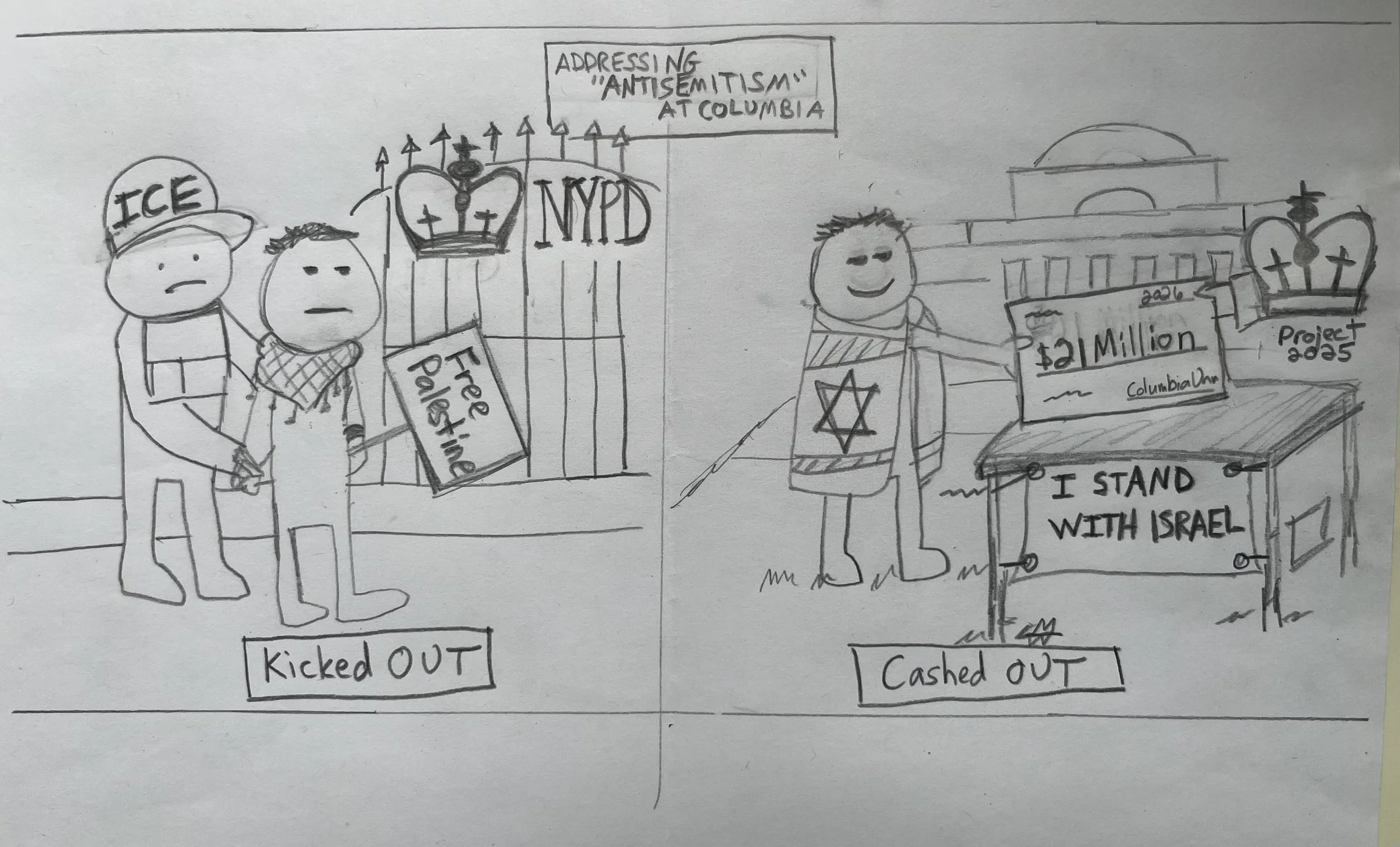
Drawing by an in-residence aspiring cartoonist
Addressing “Antisemitism” at Columbia: Kicked Out or Cashed Out
By The Specter Editorial Staff
Columbia students, Feb 20, 2026, are heading to Washington to participate in the U.S. Commission on Civil Rights’ listening session on antisemitism. The Commission says it is investigating the federal government’s response to the “rise” of antisemitism on campus.
On this campus, however, the charge of antisemitism has increasingly served as a deflection, shifting scrutiny from state violence to student speech.
Over the past year, criticism of Israel’s military conduct in Gaza—phrased in the language of international law, civilian casualties, war crimes, and genocide—has been steadily recategorized as antisemitism. “Free Palestine” and “End the Genocide” has become prima facie evidence of bias. Protest has become harassment. Political speech has become civil rights violation.
The consequences have been asymmetrical.
The federal government revoked $400 million in funding.
Columbia negotiated a $221 million settlement to get back the funding, including a $21 million, EEOC class fund to compensate antisemitism claimants. Departments were restructured. Oversight expanded. Compliance demonstrated.
Meanwhile, pro-Palestinian student protesters were kidnapped and detained by ICE, arrested, suspended, expelled, and publicly condemned, in addition to being labelled antisemitic.
In practice, antisemitism has functioned less as a legal standard and more as a political accelerant. Once invoked, it triggers investigations, funding threats, and negotiated payouts. It converts geopolitical critique into institutional liability.
The Commission says it will examine trends “historically” and prioritize a “diversity of viewpoints.” It should also examine how the definition itself has expanded—how opposition to a foreign government’s actions including genocide has been reframed as discrimination against a people.
There is a difference between hatred of Jews and opposition to a state’s policies. On this campus and across the country (and world) that distinction has been deliberately blurred, allowing political criticism to be recast as prejudice and shielding power from scrutiny.
While some get kicked out in handcuffs, others cash out with settlement funds.
A university that disciplines students for calling out genocide while remaining silent about the violence they are protesting cannot claim neutrality. With President-designate Mnookin set to take office soon, Columbia can choose to change course.
Restoring trust will require more than compliance with federal demands, it will require affirming that no government (Israel nor the United states) is beyond criticism, and that naming war crimes or genocide is not an act of hatred but an exercise of moral clarity.
