
Post #24

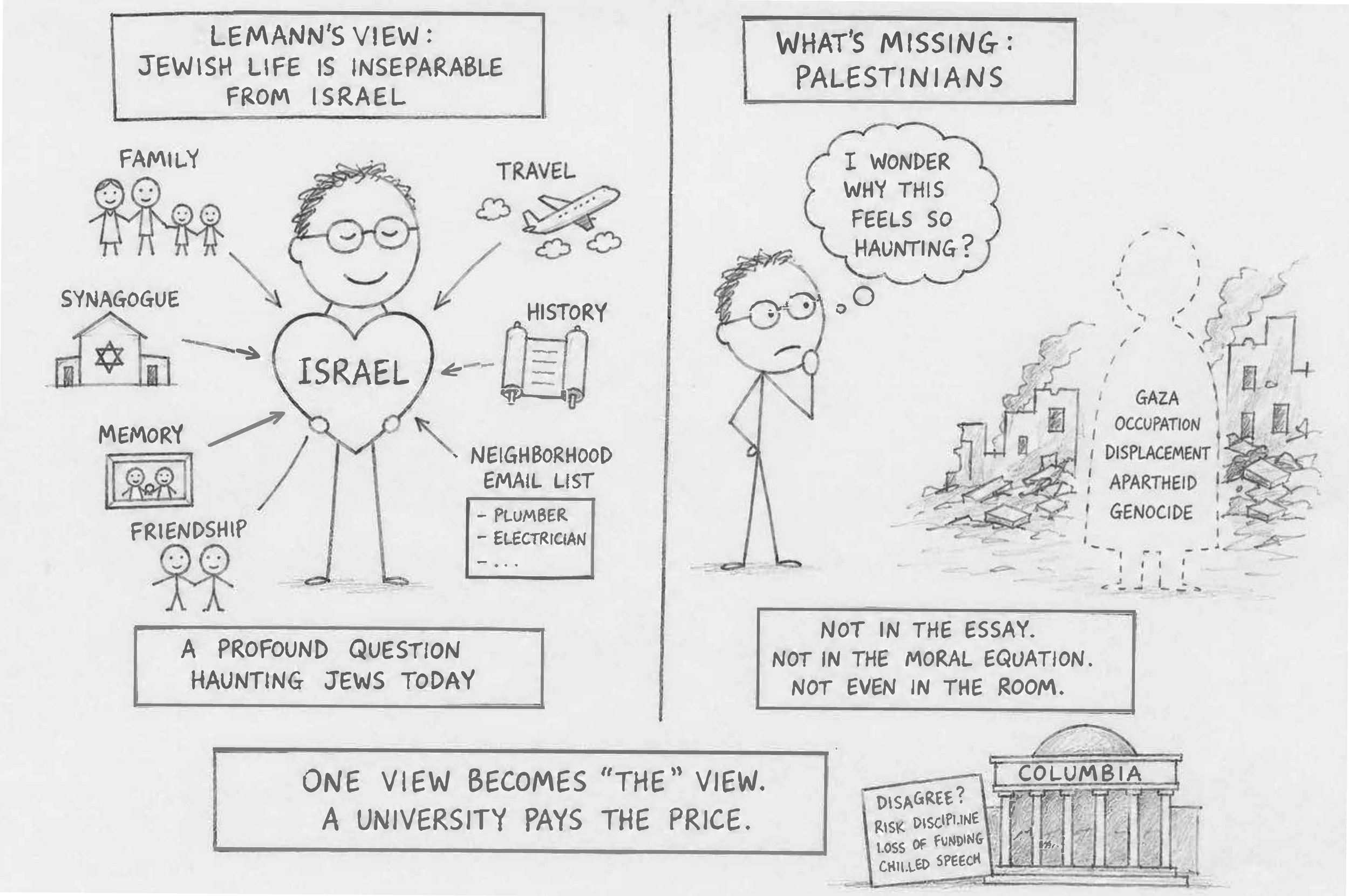
Drawing by The Specter at Columbia
Something Is Haunting Indeed
What Nicholas Lemann's Essay Reveals About Columbia's Task Force on Antisemitism
by two members of The Specter Editorial Staff, Melanie Wall and Yannik Thiem
Nicholas Lemann's recent New York Times essay, "A Profound Question Haunting Jews Today," will no doubt be read by many as a personal reflection on American Jewish identity. At Columbia, however, it also reads as something else.
Lemann was one of the three co-chairs of Columbia's Task Force on Antisemitism, together with Esther Fuchs and David Schizer. The Task Force's reports became central documents in Columbia's effort to understand antisemitism and shape its response to the campus conflicts of the past two years. Lemann's essay therefore deserves to be read not simply as autobiography but as a revealing window into one of the conceptual frameworks that informed Columbia's response to campus protest. Read today, Lemann’s essay helps explain why Columbia continues to struggle to distinguish criticism of Israel from antisemitism and political dissent from discriminatory conduct.
The essay's central claim is that for liberal American Jews today, Zionism and full acceptance within progressive political life increasingly appear to have become incompatible. Yet—and here is the "profound question haunting Jews today," as Lemann puts it—a "psychological divorce from Israel" is impossible. Israel, Lemann explains, is woven deeply into ordinary American Jewish life: through family, friendships, synagogues, memory, travel, and even the mundane exchanges of neighborhood email lists recommending contractors for home repairs: “It’s hard to imagine a week going by on our resolutely apolitical internal email list, heavily devoted to recommendations of plumbers or electricians, that doesn’t mention Israel as a routine aspect of life’s logistics.”
The example of the email list seems at first like a charming anecdote – rhetorical flourish adding little to the already mentioned point about deep personal ties. Yet, it is a striking image that is also revealing. The distinction between Jewishness and Israel quietly disappears. Israelis in the essay are Jewish Israelis. Palestinians, the people most affected by the political project under discussion, are almost entirely absent.
Lemann’s Israel – which cannot be “factor[ed] out of American life” without demanding US Jews “give up a portion of our souls” – is an Israel where there are no Palestinians other than Hamas’ attack on October 7. While Lemann acknowledges “Israel’s brutally conducted subsequent wars,” one looks in vain in the essay for any trace of the Palestinians in Gaza, where tens of thousands have been killed and nearly the entire population displaced by Israel’s military. Or for the Palestinians living under military occupation in the West Bank. Or for the Palestinian citizens of Israel. Palestinians do not even appear in Lemann’s essay as participants in the dilemma of American Jewish identity and belonging that the essay tells us has intensified since October 7, 2023.
It is not even the fact of the absence of Palestinians that is the most revealing aspect of Lemann’s essay. After all, the essay spans two centuries of US Jewish history, identity, and belonging and shows how American Jewishness was shaped by the efforts of seeking to belong in a polity which never relinquished the Protestant Christian underpinnings that dictate how religious difference can be integrated in the US nation state project. The absence of Palestinians and how their sole appearance is in the form of one mention of Hamas give the readers insight into the moral landscape and its affective infrastructures that are the backdrop against which the work of Columbia’s Antisemitism Taskforce took place. That omission matters not simply because it impoverishes the essay's moral universe. It matters because an institutional framework built on that moral universe will inevitably struggle to recognize Palestinian experience as equally relevant when evaluating campus conflict.
The moral landscape on display is strikingly narrow. It is constructed almost entirely from within one strand of American Jewish experience. Non-Zionist and anti-Zionist Jews largely disappear as moral subjects. Palestinians appear only through the violence of Hamas, not as a people living under occupation, siege, or unequal citizenship, and not as participants in the ethical questions the essay raises. If this is the conceptual landscape through which antisemitism is understood, it is hardly surprising that Columbia has struggled to understand why so many members of its own community experienced its response as profoundly one-sided.
Lemann presents the growing tension between Zionism and progressive politics in the US primarily as a crisis of Jewish belonging and Jewish survival. Antijudaism and antisemitism and the long histories of violence motivated by them are undeniable. Political Zionism arose in the context of European nationalism and out of the long histories of antisemitic pogroms against European Jewish communities. Lemann explains, “Zionism touched a deep collective yearning for self-determination, for self-protection, for freedom from perpetual outsider status.” The crisis for Lemann now is one where once again “the idea of living as fully accepted Americans adhering to universal values was a fantasy.” It is an existential crisis for Lemann where what is at stake is nothing less than how to ensure the safety and survival of Jewish life. Universal rights and values are a lovely dream, but it is only the Realpolitik of a nation-state project that can offer true protection.
In answer to the question “What is to be done?”, Lemann counsels “It helps to begin by adjusting expectations. It’s an illusion to think that Jewishness can ever be entirely comfortable or that our identity can be made to comport seamlessly with some set of universal ideals.” But many people—including many American Jews—experience the issue differently. Their concern is not that Jewish identity is too particular. It is that a political commitment to a nation-state cannot be separated from the consequences of that state's actions.
That question about the role of a political commitment to a nation-state and what it means becomes especially important at Columbia.
Universities are asked to distinguish criticism of the nation-state of Israel from antisemitism and discrimination and bias on the basis of national origin. They are asked to protect Jewish students and Israeli students (be they Jewish, Palestinian, Muslim, Druze, Christian, or other Israelis) from harassment while also protecting political dissent, including criticism of Zionism. Those are difficult distinctions. They require careful institutional judgment.
Read alongside Columbia's recent history, the essay illuminates a conceptual difficulty at the heart of the university's response. If attachment to Israel is treated as constitutive of Jewish identity, then criticism of Israel is almost destined to be interpreted as injury to Jewish identity itself. Once that conceptual move is made, the university's ability to distinguish political disagreement from discrimination begins to collapse. Lemann never states this conclusion explicitly. Yet his essay describes a worldview in which Israel is an Israel haunted by the absence of Palestinians and in which Israel occupies such a central place in Jewish life that disentangling the two becomes almost unimaginable.
That may describe the experience of many Jews. Universities, however, are not asked to govern from within one community's experience. They are asked to govern among many. It cannot become the organizing principle of a university. This conceptual slippage does not remain theoretical as Columbia repeatedly investigated or sanctioned expression directed at Israel or Zionism as though it were necessarily directed at Jewish identity. Many members of the community—Palestinian, Arab, Muslim, Jewish, and others—experienced this not as even-handed protection from discrimination but as the institutional privileging of one account of Jewish identity over competing Jewish and Palestinian understandings.
The problem is the repeated shift from "my experience" to "our experience," and finally to "Jews today." One particular history—that of a liberal American Ashkenazi Jew of a particular generation with a particular relationship to the state of Israel—gradually becomes an account of Jewish identity itself.
The question for Columbia is what happens when a particular account of Jewish identity becomes an institutional framework for understanding antisemitism.
A university cannot assume that one way of being Jewish is the measure of Jewishness, nor can it assume that criticism of Zionism is experienced uniformly by Jews. Many Jewish members of this community reject that premise. Many Palestinian, Arab, Muslim, anti-Zionist Jewish, and other members of the Columbia community would describe themselves as having experienced the consequences of that assumption.
Columbia need not concern itself with adjudicating anyone’s psychological attachment to Israel. Nor is it charged with deciding which understanding of Jewish identity is correct, or determining the proper relationship between Jews and Israel and what vision of Israel. Those are personal, religious, and political questions on which members of the university will disagree.
A university’s responsibility is different: to protect members of its community while preserving the freedom to disagree about history, nationalism, and state violence.
The question for Columbia is not whether many Jews experience Israel as inseparable from their identity. Many plainly do.
The question is whether it should remain the conceptual framework through which the university understands antisemitism.
Columbia's new leadership has an opportunity to answer that question differently. It is not bound to inherit this framework unquestioningly. It has the opportunity—and the responsibility—to rethink it.
