Post #19

Columbia’s Grant-making Raises Questions About Funding for Pro-Israel Advocacy Groups (including AIPAC)
By The Specter Investigation Office
Columbia University, through its grantmaking operations, has directed substantial funding to a set of organizations engaged in pro-Israel advocacy, according to publicly available IRS tax filings.
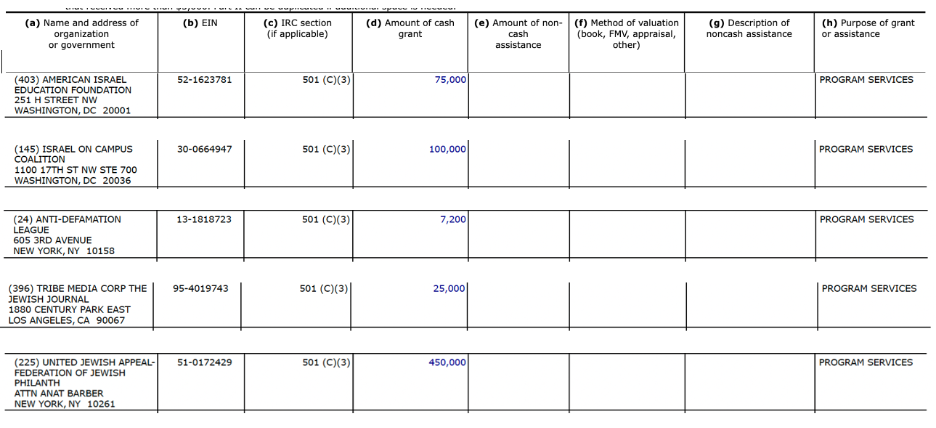
The details are not hidden. The Specter Investigation Office has found them listed in Columbia’s 990 Schedule I (“Grants and Other Assistance to Organizations”), under “program services”. While the filings clearly document the recipients and amounts, they provide no explanation of how these grants are selected or approved.
A review of the reports filed for the fiscal year ending June 2024 shows that Columbia allocated funds to multiple organizations whose missions and activities are aligned with pro-Israel political advocacy, leadership development, and media.
Among the listed grants:
Columbia gave $75K to the American Israel Education Fund (AIEF), a non-profit arm of AIPAC that sponsors educational trips and leadership programs designed to strengthen US political and institutional support for Israel. Why is Columbia funding this organization? AIEF is hardly under-resourced when its president Richard Fishman earns $1.2 million a year.
Columbia gave $100K to the Israel on Campus Coalition (ICC) whose motto is “On Campus, They Stand Up For Israel. We Stand Behind Them.” The ICC is supported by Israel’s Jewish National Fund and each year holds a 3 day National Leadership Summit in Washington DC to give “participants unique access to influential pro-Israel leaders, politicians, entrepreneurs, and activists, uniting these forces to harness their expertise, address today’s critical issues, and inspire student leaders from college campuses across the country.” (Full quote here.”) Why is Columbia funding a national political advocacy to encourage pro-Israeli politics of its students?
Columbia gave $25K to Tribe Media's Jewish Journal a pro-Israel media outlet based in California which amplifies pro-Israel groups such as the ICC. Why is Columbia giving money to this media organization with a clear political orientation?
A smaller grant of $7,200 went to the Anti-Defamation League (ADL), a pro-Israel advocacy organization that has drawn significant criticism in recent years for its political positions and associations. Columbia began funding the ADL even before formally adopting the IHRA definition of antisemitism and partnering with the organization for campus training. What prompted the financial relationship to precede the institutional one?
The largest single allocation identified in this category was $657,000 to Columbia’s Hillel , nearly double the amount reported the previous year. Some students have raised concerns about whether Hillel adequately reflects the full diversity of Jewish perspectives on campus. No comparable institutional funding appears for other campus religious organizations, why this one?
Columbia also gave $450,000 to the United Jewish Appeal. By comparison, the filings show $10,000 to Catholic Charities and no reported grants to Muslim organizations.
Taken together, these allocations reflect a pattern of funding concentrated among organizations connected to pro-Israel advocacy and community networks.
A review of publicly available 990 filings from peer institutions suggests that this pattern is not typical. Other Ivy League universities and New York University do not appear to provide comparable levels of funding to campus Hillel organizations, nor do they consistently fund the same set of pro-Israel advocacy groups.
Yale University’s $1 million contribution in November 2023 to the Friends of the Israel Defense Forces, made through a donor-advised fund, drew widespread attention precisely because it was unusual.
At Columbia, however, similar pro-Israel categories of giving appear across multiple organizations.
At the same time, there is little public information about how these decisions are made. Columbia’s Board of Trustees does not publish minutes of its meetings or provide detailed public records of its deliberations or votes. As a result, there is no clear way for faculty, students, or the broader university community to understand how grantmaking priorities are set or reviewed.
The university’s tax filings make the financial allocations visible. The decision-making process behind them remains largely opaque.
See Below a snipit of Columbia’s filings FY 2024.