
Post #20

Securities Fraud Case Ends in $15M Settlement for Columbia Trustee Shoshana Shendelman
By The Specter Investigative Team [updated 7:10am 4-14-2026]
Columbia University trustee Shoshana Shendelman has agreed to a $15 million settlement resolving a securities fraud class action tied to her tenure as CEO and founder of Applied Therapeutics, according to filings dated March 19, 2026 in the Southern District of New York.
The court approved a $15 million settlement fund and dismissed the case with prejudice. As is standard in such settlements, the agreement includes no admission of wrongdoing, allowing the matter to conclude without the inconvenience of a judicial determination.
As of April 13, 2026, Dr. Shendelman remains a trustee of Columbia University and continues to serve as Vice Chair of the Board of Advisors at the Vagelos College of Physicians and Surgeons. This is despite the removal of references to her role at Applied Therapeutics from her online profile.
Applied Therapeutics imploded at the end of 2024 after the FDA declined to approve its lead drug. An FDA warning letter documented multiple deficiencies in the conduct and reporting of the company’s clinical trial. The class action suit claims she misled investors by failing to publicly disclose FDA concerns while at the same time selling $4.7 million in company stock.
Columbia has not publicly commented on the settlement against Shendelman.
Instead, the Columbia Office of Public Affairs recently issued a statement condemning flyers that were distributed recently which “included inaccurate and inflammatory claims” and warned against “the deliberate targeting of individuals.”
The University statement does not identify the individuals referenced or specify the flyer at issue. (A portion of one such flyer circulating recently is reproduced below.) The flyers in question, however, named multiple senior University leaders, including trustees, the University’s General Counsel, and other administrators who are public-facing institutional actors some of whom have taken visible positions on contested campus issues. They also occupy positions of significant authority within the University’s governance structure.
The materials in the flyers draw on publicly available information.
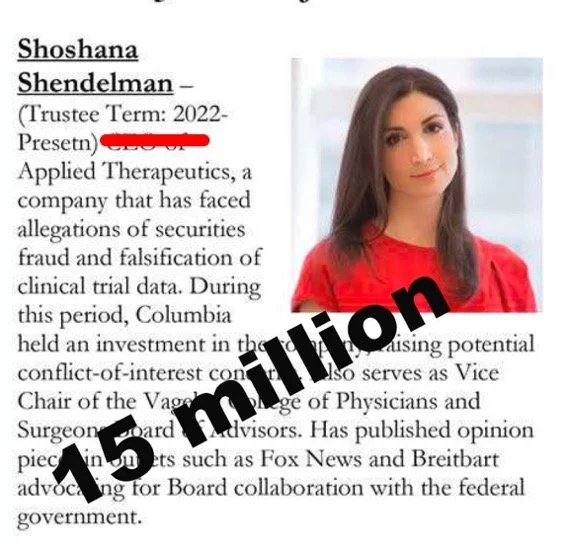
The legal filings are public. The FDA warning letter is public. The court’s final judgment is public. Information about the settlement itself is publicly available through the court-authorized claims process.
Which introduces a small complication.
If these claims are “false and unfounded,” then they have managed to survive regulatory investigation, federal litigation, and judicial review.
If they are merely “inflammatory,” then the inflammation appears to originate in the public record.
In May 2025, investigative reporting by The Intercept documented the FDA warning letter, the emerging shareholder lawsuit, and the circumstances surrounding Dr. Shendelman’s departure from Applied Therapeutics.
In public appearances that followed, Dr. Shendelman offered a different account. In a 2025 interview, she described a “broken” FDA system in which “21st-century cures” are evaluated using outdated frameworks, and suggested that regulatory failures—not corporate conduct—prevented a promising treatment from reaching patients.
This narrative, as presented in the interview, is on the face indeed appealing. But all these good intentions would make anyone find it hard to reconcile with an FDA warning letter documenting deleted clinical trial data, missing audit trails, and failures to disclose dosing errors affecting study participants.
Perhaps it is not the accuracy of the claims that CU takes issue with here. Perhaps it is the highlighting of publicly available information.
After all, it is one thing for these facts to exist in regulatory filings and court documents. It is another for them to circulate beyond those forums.
In its Office of Public Affairs statement, Columbia affirms that criticism is “a natural and necessary part” of academic life. It also reminds us that such criticism must not “undermine the meaningful exchange of ideas.”
It seems the leadership of Columbia in its official statement feels one way to preserve that exchange is to label scrutiny of leadership a form of doxxing. Or maybe what they are saying is that when specific, documented claims are made, the focus should remain on substance, for example, the pitfalls of insider trading, rather than naming who is allegedly doing it?
If the CU Board of Trustees want a meaningful exchange of ideas, they should make themselves available starting with publishing minutes of their meetings.
The University faces a delicate task: distinguishing between harassment and documentation, between narrative and record, and between protecting individuals and protecting the institution from the inconvenience of verifiable facts.
The facts, it turns out, are not in dispute.
Only their visibility.
